
 Deutsch
 English
Quality Assurance and Support
With the goal of improving the quality of doctoral programs and the conditions for early-career researchers, the universities in Lower Saxony, in collaboration with the Lower Saxony Ministry of Science, have developed guidelines designed, among other things, to ensure greater transparency and consistency in doctoral procedures and to facilitate collaborative doctoral programs.
Clausthal University of Technology plans the long-term implementation of tools to further develop doctoral advising in order to
- promote the quality of doctoral dissertations across disciplines and faculties,
- increase the appeal of doctoral programs at Clausthal University of Technology on a national and international scale,
- and ensure that Clausthal University of Technology remains eligible to apply for structured and coordinated national and international funding programs.
Advisory framework for doctoral supervision
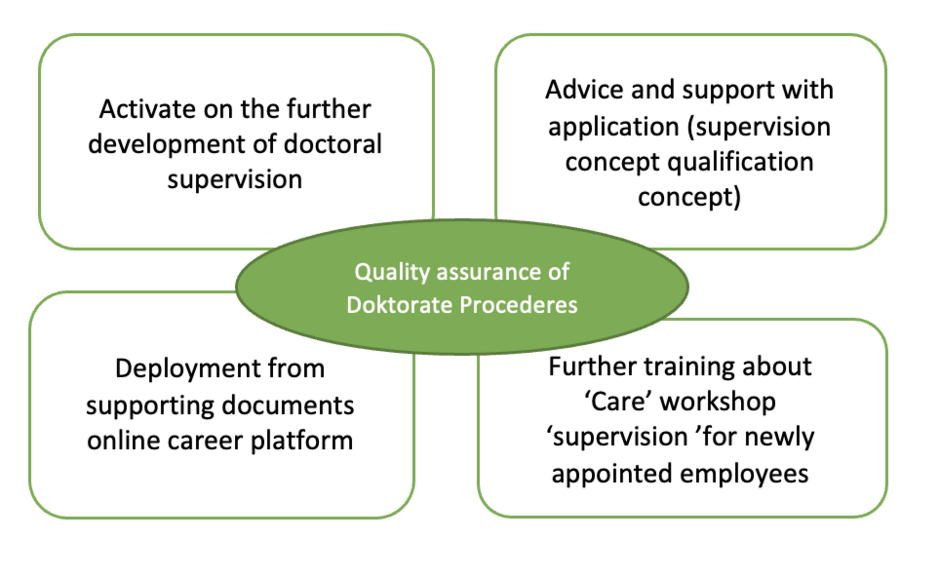
The Graduate Academy offers advice to researchersand researchgroups on the implementation of instruments for the further development of doctoral supervision
The consultation can take place individually or together with the entire research group, for example in a workshop format. The focus here is on the joint development of standards and methods that can be implemented step by step in your own day-to-day research. If you would like advice, please contact us.
“Professional Development and Career” Online Platform to Support Researchers
The platform provides access to professional development opportunities for all employees. We are happy to advise you on developing a personalized curriculum for targeted career development. As part of the annual performance review process outlined in the employment agreement, we encourage researchers in training phases and their advisors to conduct career discussions. Guidelines for conducting these discussions can be found in our handbook.
The documents are also available in print. The information brochure Doing a doctorate in Clauthal provides information about the basic process of a doctorate at Clausthal University of Technology and is intended to give international doctoral candidates in particular an insight into doctoral procedures and provide assistance with contact options. Additional documents provide information on national standards and recommendations for structuring a doctoral program (e.g., guidelines on quality assurance in doctoral procedures from the State Higher Education Conference and the Lower Saxony Ministry of Science and Culture, “Shaping the Doctoral Program Together—Recommendations for Doctoral Candidates and Advisors” from the Doctoral Quality Circle).
Professional development programs on leadership, power, and supervision
for newly appointed and junior professors, as well as for young research group leaders who play a key role in supervising doctoral candidates. These may include professional development opportunities such as workshops, as well as events featuring experience reports from seasoned professors or individualized support measures.
Advice and support for researchers in the grant application process, with a focus on doctoral colleges
This advising and support is provided in collaboration with the Funding Advisory Department of the Service Center for Research and Transfer. Against the backdrop of quality assurance, the Graduate Academy provides advice on supervision and professional development. The basis for this is the guide to establishing doctoral colleges, which includes model regulations and a model curriculum. We work together to develop quality-assured supervision and training concepts. In particular, the Graduate Academy advises and reviews whether standards are being met and whether appropriate measures should be implemented. To assist with this, relevant text modules for grant applications can also be provided. If you would like advice, please contact us.
Responsibility in Science
Scientific work is based on principles that are the same in all countries and across all scientific disciplines. Foremost among these is honesty towards oneself and others. It forms the basis for treating one another, research participants, animals, cultural heritage and the environment with respect, and is essential for maintaining society’s indispensable trust in science.
At the same time, it serves as both an ethical standard and the foundation for the rules of scientific professionalism – that is, good scientific practice – which vary from discipline to discipline. Conveying these principles to students and early-career researchers, and ensuring the conditions for their observance and application in practice, is a core task of teaching and the self-governance of science.